
 |
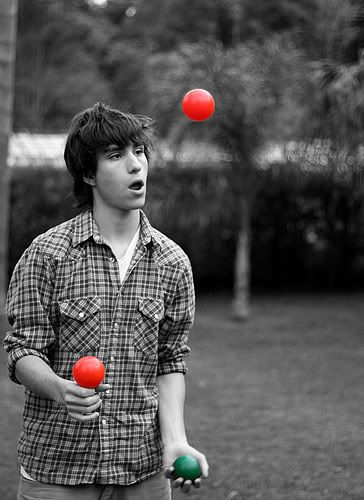
| Photo by Flickr user lrargerich |
करत करत अभ्यास के, जड़मति होत सुजान
रसरी आवत जात ते, सिल पर पड़त निसान
We are taught to rote the mathematical multiplication tables or to mug up nursery rhymes ... the list is endless. And we all HATE IT! Even as we grow up we start disdaining and condemning the method of rote which is perpetuated across the educational system.
However, secretly we all know that we benefit somewhere from some of the rote we did. When you secretly calculate the percentage of your increment or the approximate EMI required to fund the next investment we remember our math tables.
Yesterday, as I was watching Mtv Unplugged, I realized one more advantage of practicing any activity or art. As I watched the guitarist or the tabla player play their instrument so effortlessly and then experiment with it during the event - I realized that had they not been so adept at playing the instrument, they would never have been in a position to experiment.
To detail it out, when we start learning any activity or art. the conscious mind is occupied with 'learning' the nuances of the regular stuff that goes into it. But with practice, most nuances simply seep into the subconscious leaving the conscious mind free for noticing the matters which separate excellence from the average.
For example, for a kid learning cricket he needs to pay attention to the way he holds his bat, placement of the bat and the foot etc. However, as we start practicing, these nuances seep into his subconscious - a professional cricket player need not bother to think if his bat is placed at the correct angle, at the correct distance from his foot and the wicket etc. All this, as we say, comes naturally to him in his "style". So now s/he can concentrate on where the fielders are, where to play the next shot to score a boundary etc.
Similarly, as a student of computer programming, you often start with experimenting how a for-loop or if-then-else ladder works; you play with it, experiment its nuances. Once you've learnt the ropes, you can concentrate on problem solving - analyzing the business logic which comes to you and think what are the most effective programming tools available to you to address the logic.
This is true of all fields - as we practice the mind becomes oblivious to the granular details of the art/activity giving us the freedom to use this "practiced" mind for higher goals. In essence, practice makes you perfect - but more importantly grants you the freedom to achieve the higher things in life than the mundane stuff that you were made to practice. This I think, it the biggest virtue of practicing - freedom!
.
However, secretly we all know that we benefit somewhere from some of the rote we did. When you secretly calculate the percentage of your increment or the approximate EMI required to fund the next investment we remember our math tables.
Yesterday, as I was watching Mtv Unplugged, I realized one more advantage of practicing any activity or art. As I watched the guitarist or the tabla player play their instrument so effortlessly and then experiment with it during the event - I realized that had they not been so adept at playing the instrument, they would never have been in a position to experiment.
To detail it out, when we start learning any activity or art. the conscious mind is occupied with 'learning' the nuances of the regular stuff that goes into it. But with practice, most nuances simply seep into the subconscious leaving the conscious mind free for noticing the matters which separate excellence from the average.
For example, for a kid learning cricket he needs to pay attention to the way he holds his bat, placement of the bat and the foot etc. However, as we start practicing, these nuances seep into his subconscious - a professional cricket player need not bother to think if his bat is placed at the correct angle, at the correct distance from his foot and the wicket etc. All this, as we say, comes naturally to him in his "style". So now s/he can concentrate on where the fielders are, where to play the next shot to score a boundary etc.
Similarly, as a student of computer programming, you often start with experimenting how a for-loop or if-then-else ladder works; you play with it, experiment its nuances. Once you've learnt the ropes, you can concentrate on problem solving - analyzing the business logic which comes to you and think what are the most effective programming tools available to you to address the logic.
This is true of all fields - as we practice the mind becomes oblivious to the granular details of the art/activity giving us the freedom to use this "practiced" mind for higher goals. In essence, practice makes you perfect - but more importantly grants you the freedom to achieve the higher things in life than the mundane stuff that you were made to practice. This I think, it the biggest virtue of practicing - freedom!
.
Comments
Post a Comment