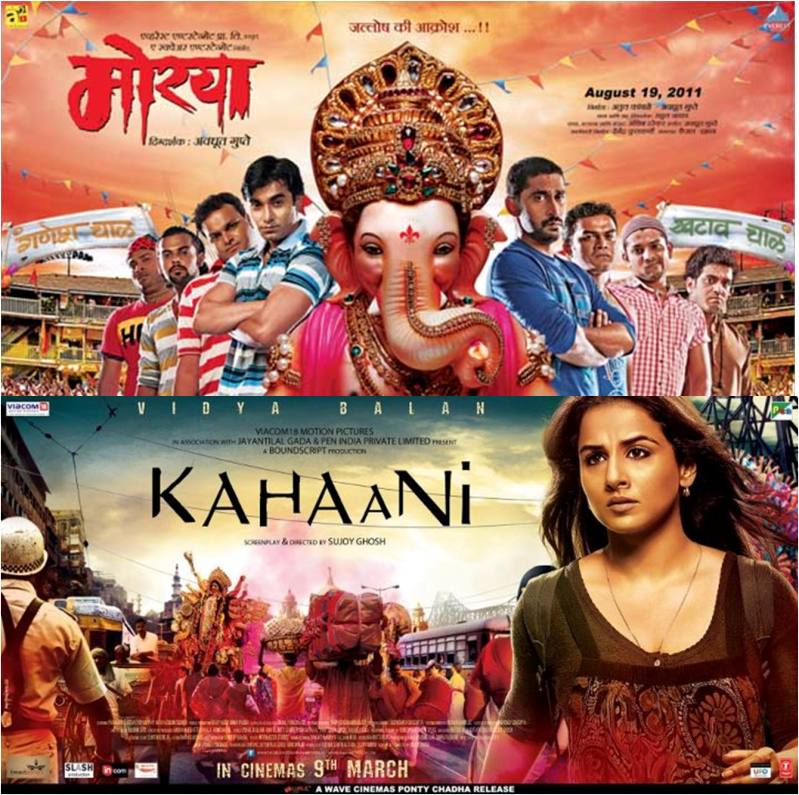
New cinema for the new India

There is no doubt that Indian society has transformed in the past 2 decades and our cinema has transformed along with it - everything has changed. Indian movies are nowadays technically far superior, editing and conceptualization of sets etc are good, and finally story lines are far more mature (though many of them still continue to be copies of Hollywood counterparts).

Nevertheless, Indian cinema continues to differentiate itself from Hollywood in that its essence is closely influenced by human relations, beliefs and metaphysical constructs (religion, love et.al.). The latest two movies I watched - Morya (in Marathi) and Kahani (Hindi)- reinforced my belief that Indian cinema is transforming itself while maintaining that differentiation with Hollywood.

Morya portrays the rivalry between two chawls in Mumbai in organizing the local Ganesh pandal festival - illustrating how the festival which was conceptualized a public organization by Bal Gangadhar Tilak to unite people against the British is now causing factionalism - defeating the purpose. The movie ends in typical 80s style with the protagonists realizing their mistake murder the villainous politicians in true vigilante style but scrape through thanks to a benevolent police officer. However, what is remarkable is how religious subtext is dealt with dispassionately without any sequences showing the deity "causing" any miraculous turnarounds.

Kahani on the other hand is a new age thriller, a story of how a pregnant woman (Vidya Balan) trying to locate her lost husband gets involved in an Intelligence failure story and ends up delivering results to the IB (Intelligence Bureau) agents. The metaphysical connect of the movie delivers at the end where the voice over compares Vidya's character to Maa Durga delivering justice drawing the analog to Maa decimating the Asuras.     There is again no "mystic deliverance" depicted in the movie - but the connect shown by the analogy maintains the overall tone of the movie.

 The above two movies are just indicative how Indian cinema is adapting to a change in the audience sentiment which is now rational, yet (ironically) is still metaphysical and religious in its inner mental make up. I find this a happy transformation - thankfully Indian cinema is not aping Hollywood as many predicted a couple of years ago and is developing an identity of its own.

Comments

  1. Indeed ..and the transformation was also seen with the series of awareness films like tare zameen par, my name is khan, paa ..and thought provoking ones like 3 idiots. Certainly, we are moving forward and are growing much distinct from the typical older movies. Change for the good-well said.

    ReplyDelete

Post a Comment

Popular posts from this blog

Vikramaditya - Myth or Reality

  A statue of Vikramaditya at  Vikramaditya ka Tila / Vikramaditya's Singhasan Battisi On a recent visit to Ujjain, I found myself drawn to the city's extraordinary blend of history, mythology, and spirituality. As I stood before the Mahakaleshwar Jyotirlinga, I reflected on its significance as one of India’s most revered shrines. Yet, amidst these sacred surroundings, I encountered narratives of Vikramaditya - the legendary king of Ujjain, celebrated for his valor and wisdom, who's name resonates from the folklore of locals to every part of India. Every time we celebrate a festival in India, it is marked with a tithi i.e. date as per the Indian calendar - which is called the Vikram Samvat calendar, attributed to being founded by Vikramaditya of Ujjaini (the then name of Ujjain). What struck me, however, was the curious fact that despite Vikramaditya’s pivotal place in Indian cultural memory, his existence as a historical figure lacks definitive evidence. My exploration l...

Ekla Chalo re

Watched "Bose- The forgotten Hero" on Saturday. Gem of a movie and probably the best of Shyam Benegal. Subhash Chandra Bose has always been an inspiring character in the history for the youth. This post however is not about the movie, its about the lead song 'Tanha Rahee' which is based on the poem 'Ekla Chalo Re' by Gurudev Rabindranath Tagore. I had pasted the English translation of this poem on my blog earlier. http://the-complete-man.blogspot.com/2004/12/tsunami-times_30.html However, yesterday I found the original bengali text of the poem and found that the meaning in the above translation was not exact. So I have endeavourer (with the help of Shubham ) to re-translate it into English and Hindi by myself. Here is the output of my work: Bengali Jodi Tor Dak Soone Keu Na Asse Tobe Ekla Chalo re Ekla Chalo Ekla Chalo Ekla Chalore Jodi Keu Katha Na Kai Ore Ore O Abhaga Jodi Sabai Thake Mukh Firae Sabai Kare Bhay Tabe Paran Khule O Tui Mukh Fute Tor Maner Kath...

How will travel industry transform post-Covid

Unlike philosophers, journalists and teenagers, the world of entrepreneurship does not permit the luxury of gazing into a crystal ball to predict the future. An entrepreneur’s world is instead made of MVPs (Minimum Viable Product), A/B Tests, launching products, features or services and gauging / measuring their reception in the market to arrive at verifiable truths which can drive the business forward. Which is why I have never written about my musings or hypothesis about travel industry – we usually either seek customer feedback or launch an MVPised version and gather market feedback. However, with Covid-19 travel bans across the globe, the industry is currently stuck – while a lot of industry reports and journalistic conjectures are out, there’s no definitive answer to the way forward. Besides there is no way to test your hypothesis since even the traveller does not know what they will do when skies open. So, I decided to don my blogger hat and take the luxury of crystal gazing...