The no-man's-land syndrome

Narendra Modi's Swatch Barat campaign faces lot of hurdles - changing people's mentalities, overcoming the chronic issues of open defecation, lack of cleanliness infrastructure (starting from dustbins to garbage collection trucks) etc.

But one problem faced by it is indeed the no-man's-land syndrome also known as not-my-problem syndrome or outside my zone problem :-).

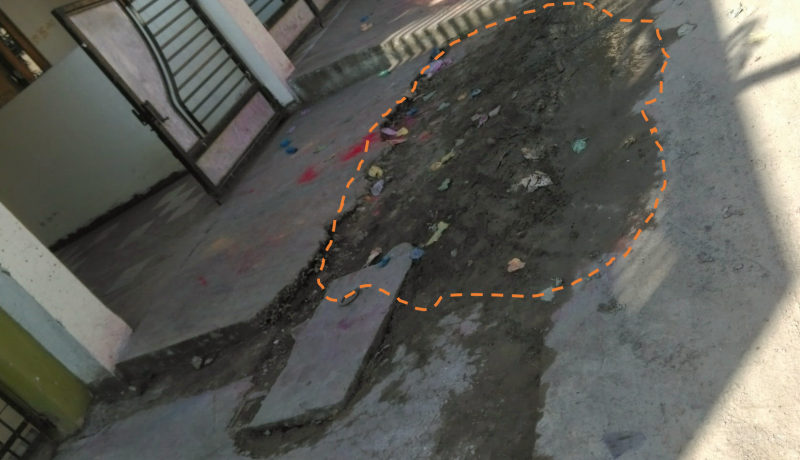
Check out the image - the house owner has cemented the ramp up from the road to his porch and the municipality has made a cement road right upto the pavement; yet a short portion between the two cemented portions is left out for mud and water to accumulate.

I must admit that this picture was taken a day after the festival of Holi, so the muck of mud and water is more dirty than usual with remains of water balloons and color from previous day's holi celebrations. Nevertheless, this does not take away the problem - the fact that our systems fail at boundaries.

This manifests across levels of ownership - the boundary between the house / bungalow and the road is dirty, so is the boundary between two residential colonies or a municipal district and adjoining rural (village panchayat) one, and for those who live in Megapolices like Greater Mumbai and NCR - the boundaries between two district / state administrations is as filthy as it could be.

Interestingly, some border zones such as toll gateways are well maintained, spic and clean but just run a few meters away from such controlled zones, the area stinks of urine, the populace in these areas usually lives in slums and not recognized colonies. And the problem is not just about cleanliness - it is true about road conditions, public amenities and populations alike. To be sure, these areas are not ungoverned sectors (and so technically are not 'no-mans'-land) but form a part of either of the precincts; however are often neglected portions.

How do we solve this problem? Is these a different law to be made for boundaries? Do we have separate institutions for maintenance of boundaries between two districts or two municipalities? Do we define a set of rights for citizens living in these border zones?

The answer beats me - it is possibly not so much a jurisdictional and civil problem as it is a problem with mentality and ownership. It is more of a problem of cooperation and ownership between various silos of governance.
.

Comments

Popular posts from this blog

Ekla Chalo re

Watched "Bose- The forgotten Hero" on Saturday. Gem of a movie and probably the best of Shyam Benegal. Subhash Chandra Bose has always been an inspiring character in the history for the youth. This post however is not about the movie, its about the lead song 'Tanha Rahee' which is based on the poem 'Ekla Chalo Re' by Gurudev Rabindranath Tagore. I had pasted the English translation of this poem on my blog earlier. http://the-complete-man.blogspot.com/2004/12/tsunami-times_30.html However, yesterday I found the original bengali text of the poem and found that the meaning in the above translation was not exact. So I have endeavourer (with the help of Shubham ) to re-translate it into English and Hindi by myself. Here is the output of my work: Bengali Jodi Tor Dak Soone Keu Na Asse Tobe Ekla Chalo re Ekla Chalo Ekla Chalo Ekla Chalore Jodi Keu Katha Na Kai Ore Ore O Abhaga Jodi Sabai Thake Mukh Firae Sabai Kare Bhay Tabe Paran Khule O Tui Mukh Fute Tor Maner Kath...

A lakh! A Crore! ... then why not an Arab?

India is a true melting pot - and the language we speak are true representations of the same. In any given location, the way people speak (the dialect, the accent and vocabulary inclusive) is a wonderful mix of local, regional, national and even a bit of international influences. To take some examples: Bangalore lingo: "Enjoy Madi!" Mumbai lingo: "Its all over Akhha Mumbai yaar" Some International sprinkled in: "Dude! Hows life yaar?" All in all - India has been pretty successful in integrating its regional disparities with nationally pervasive trends and a bit of International lingo as well (thanks to its diaspora). The same has happened in terms of the numeral terminologies that we use. In India - even with the English media, we use terms like a 'lakh' (= hundred thousand) or a 'crore' (= ten million). But what is surprising is that beyond these, the media usually follows the international numeric term - billion. This is in spite of th...

Experienced vs. Freshers – an MBA perspective

Shubham and me compiled and created an article during our first year of MBA. It was never published, nevertheless MBA aspirants will find it very useful. Publishing it online for the same purpose. However, Shubham and myself claim a copyright on the text .... and of course very many thanks to all our freinds whose views have helped us compile the article. Experienced vs. Freshers – an MBA perspective By Nikhil Kulkarni, KPMG Shubham Choudhury, Infosys PGDIM- X, NITIE, Mumbai Ashita Mittal was placed during her final year in engineering college with a leading software firm. But she never wanted to be another brick in the wall. She wanted to differentiate herself from other graduates who start their career at the lowest rung of organizational hierarchy. MBA was a natural choice for her. On the other side is Shailesh Dhawla, who worked as a software engineer with a leading software consultancy firm for 3 years. He started his job with some ends in mind, like working with a known company, ...